This is the first question every founder, product manager, or business owner asks, and usually the answer they get is "it depends." That's true, but you can't plan a budget around "it depends." So here are the real numbers for 2026, including the thing most development companies would rather not talk about: AI-based development has completely changed the rules of the game. Anyone who still doesn't work this way is simply charging you too much.
Why the guides you found on Google are no longer relevant
If you searched for "how much does app development cost" two or three years ago, you got ranges of NIS 250,000 to NIS 800,000 for a serious app, and timelines of six to nine months. Those numbers were true for a world where every line of code was written by hand, every screen was designed from scratch, and every test was run manually.
That world no longer exists. Anyone pricing today as if it were 2023 either has not caught up, or is making money at your expense.
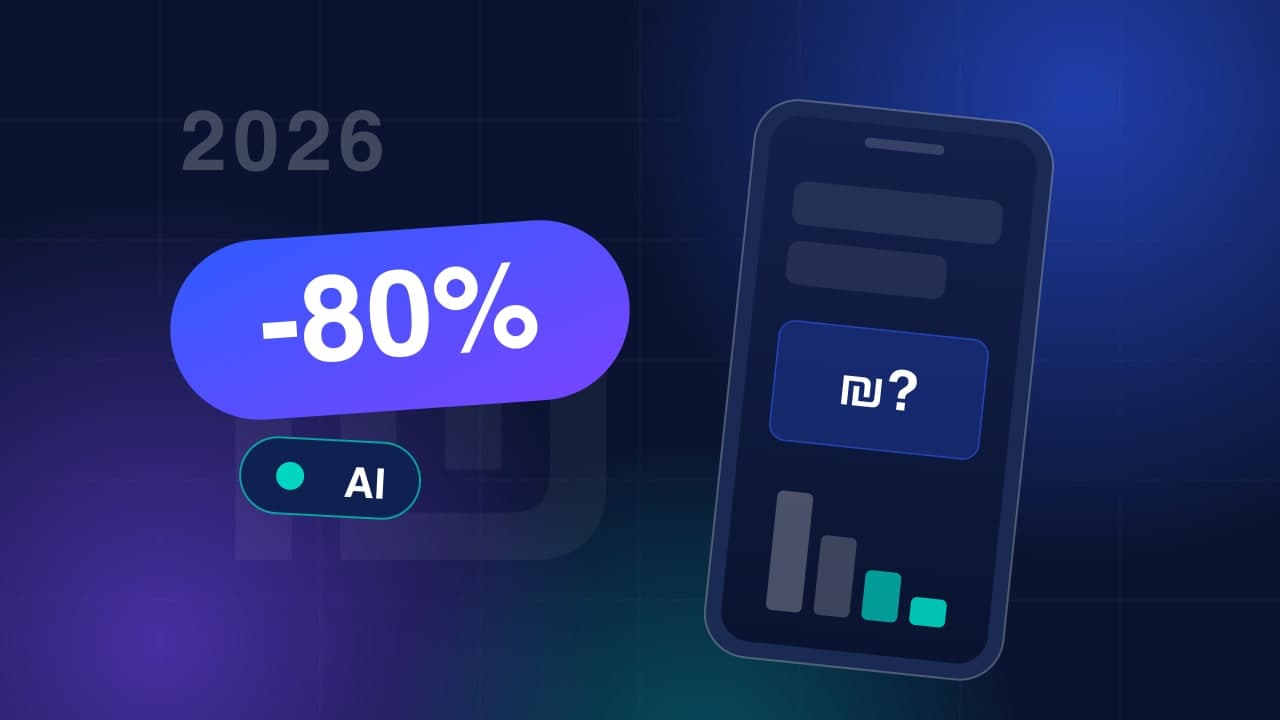
How AI cuts development costs by up to 80%
In a team that works properly with AI, AI writes a large part of the code, generates the tests, documents the system, and catches bugs before they ever reach you. Developers focus on what really matters: architecture, user experience, and product decisions.
The result in practice: what once required a team of five people for half a year is now built by a small, focused team in two to three months. In plain English: an app that cost around NIS 400,000 in 2023 can now cost NIS 80,000 to NIS 120,000, a saving of up to 80%, without compromising on quality. In fact, code written with AI and reviewed by experienced engineers usually comes out cleaner and more consistent.
Before getting excited: this saving does not happen by itself. It requires a team that has already built real products this way, workflows designed around AI from day one, and strict human review of every line. This is exactly how we work at DevShift, including on our own products.
The real price ranges for 2026
The numbers below assume AI-based development by an experienced team. At companies still working the old way, expect quotes two or three times higher for exactly the same product:
- Focused MVP NIS 40,000-90,000
Hybrid app with one core flow.
One to two months - Full app for both platforms NIS 90,000-200,000
Users, notifications, payments, and an admin panel.
Two to three months - SaaS system with built-in AI NIS 150,000-350,000
Subscriptions, integrations, and built-in AI agents.
Three to five months - Complex native app From NIS 200,000
Hardware integrations, advanced security, offline mode.
Depends on scope
What really determines the price
The number of screens and flows
An app with five screens and one flow is not the same project as an app with thirty screens, a permissions system, and three user types. This is the most significant factor in the price, long before the technology.
Native or hybrid
A hybrid app, one codebase that runs on both iPhone and Android, saves 30% to 40% of the cost and fits most products. Native is required when you need maximum performance or deep access to hardware. We explained the differences on our app development page.
Backend and integrations
Connecting to payment processing, CRM systems, admin interfaces, and existing data: every integration adds work. Here too, AI significantly shortens the timeline, but it is still a component that needs to be priced separately.
Smart features
Real-time chat, image processing, personalized recommendations, or a built-in AI agent. These features used to be the most expensive part of the project, and today, ironically, they are the part whose cost has dropped the most.
How to save without compromising on quality
- Start with a real MVP. 20% of the features deliver 80% of the value. Everything else gets added after you have real users and real feedback.
- Choose hybrid as the default. Unless there is a real technical reason for native, and in most cases there is not.
- Ask the development company how it works with AI. Not "whether," but how, with which tools, and at which stages. If the answer starts with "we are looking into it," factor that into the quote.
- Demand a detailed quote by milestones. A vague "all-in price" is the safest way to get surprises later.
The bottom line
App development in 2026 costs significantly less than it did three years ago, provided you work with someone who truly develops with AI and does not just write that on the website. The difference between a quote for NIS 100,000 and NIS 300,000 is often not a difference in quality, but a difference in the working method.
Want a real number for your idea? Tell us what you want to build and we will get back to you within one business day with an honest estimate, with no surprises later.